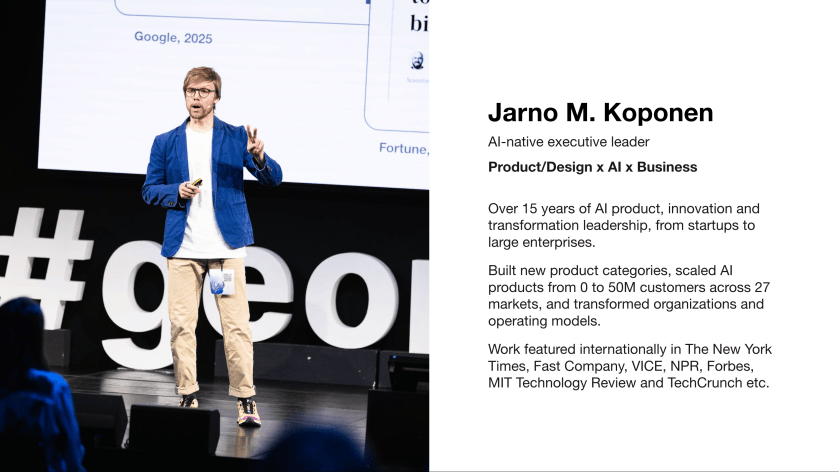
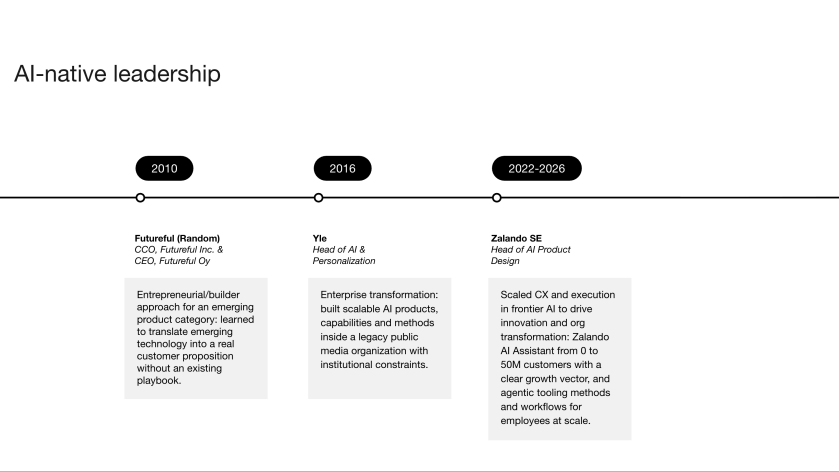
I lead where technology changes the basis of competition. I set the strategy and direction, turn it into an actionable plan across customer-facing experiences and internal tooling, and build the teams, workflows and operating models that make the change repeatable at scale. Below are three such transformations, from a San Francisco startup to 50 million customers.
How I lead transformation
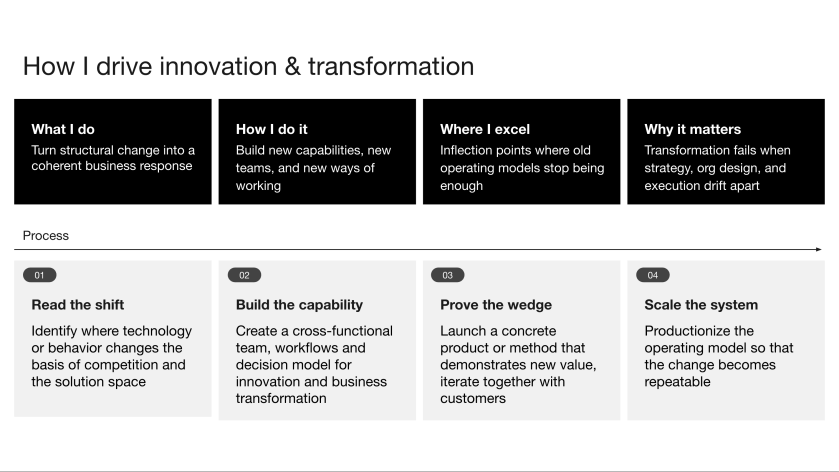
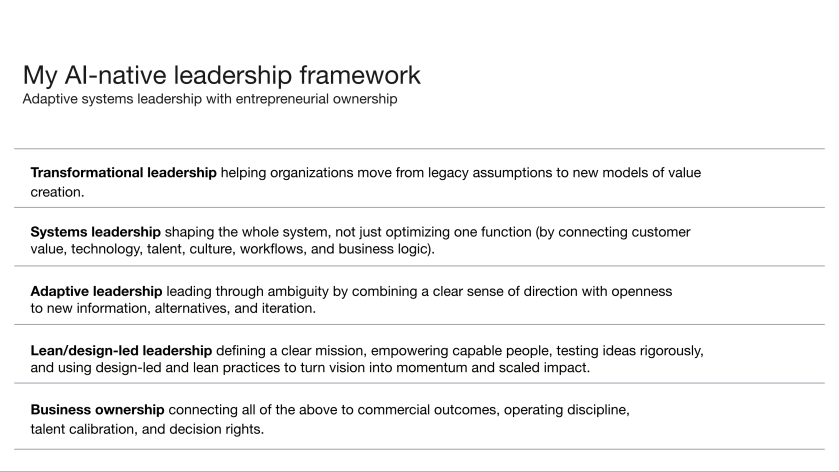
Transformation fails when strategy, organization design and execution drift apart. My job is to keep them together, from the first signal to a scaled operating model.
- Read the shift: identify where technology or customer behavior changes the basis of competition and the solution space.
- Set the direction: turn structural change into a coherent business response, with a clear mission, shared goals and KPIs, and explicit decision rights.
- Build the capability: create the cross-functional teams, AI-native workflows and decision model for innovation, across customer-facing experiences and internal tooling.
- Prove the wedge: launch a concrete product or method that demonstrates new value, and iterate together with customers.
- Scale the system: productionize the operating model, with quality evaluation, simulation and governance, so the change becomes repeatable.
At a glance
- Zalando (2022-2026): scaling frontier AI and an agent-augmented operating model
- Zalando Assistant: founding product design leader; idea to launch in under six months, scaled to Zalando’s 50M+ customer base
- Agent-augmented operating model: agentic tooling, workflows and roles as first-ever Head of AI Product Design
- Trend Spotter and Dynamic Page System: data-driven trends and personalized pages at scale
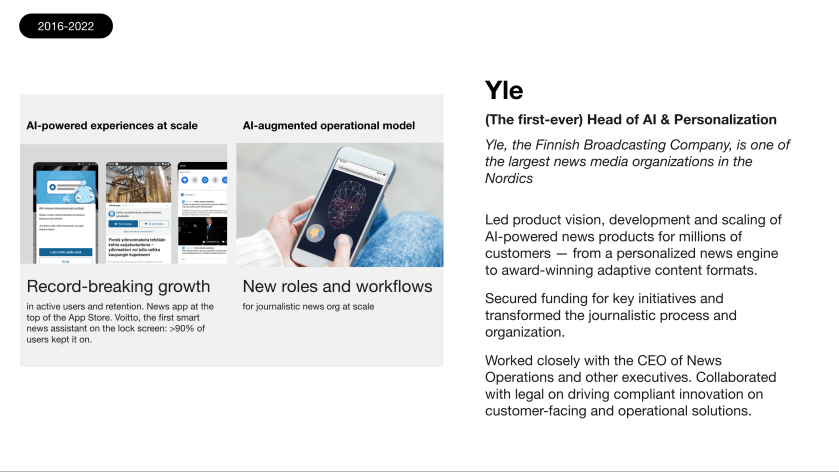
- Yle (2016-2022): transforming a public service newsroom with AI
- Yle News AI team: a new AI/ML function that broke international news stories
- Machine learning courses for journalists: with LSE Polis and Google News Initiative, in 17 languages
- Troll Factory: award-winning media literacy game played in over 100 countries
- Five million political ads: targeted political advertising simulator, 92% completion
- Voitto: first smart news assistant on the lock screen, kept on by over 90% of users
- Läheltä / Near by: hyper-local news recommendations and alerts
- Yle Uutisvahti / NewsWatch: Yle’s fastest-growing digital service in 2017
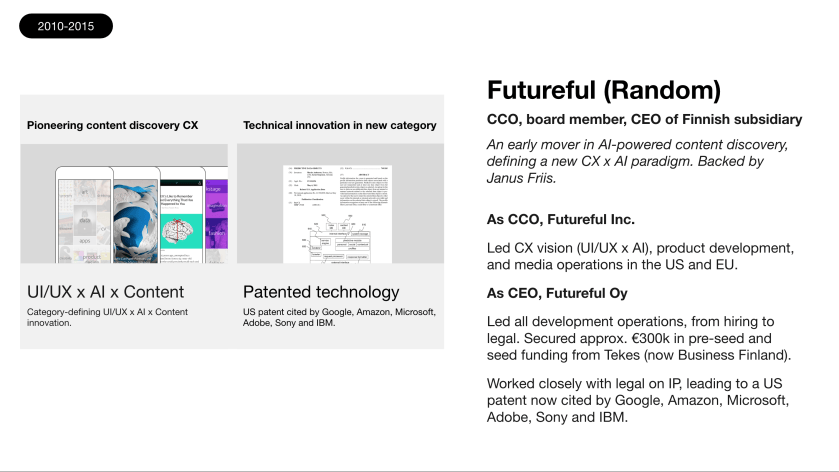
- Futureful (2010-2015): building a new product category from zero
- Random: co-founded startup; patented predictive discovery
Overview of key work and impact
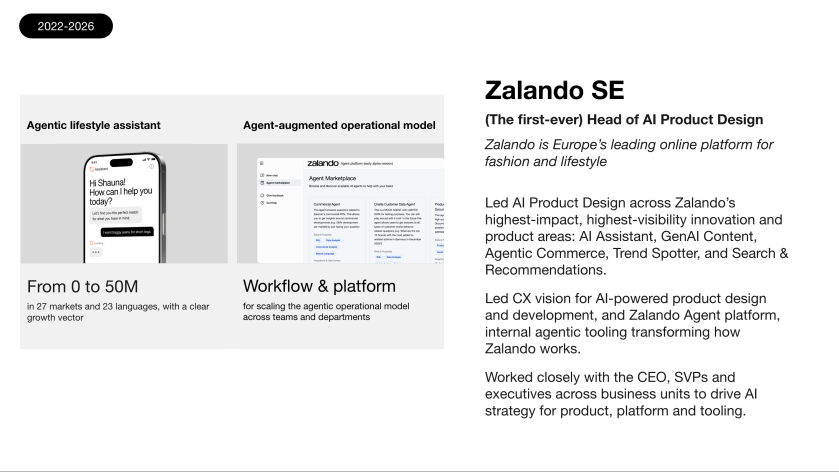
Zalando: scaling frontier AI and an agent-augmented operating model (2022-2026)
First-ever Head of AI Product Design at Europe’s leading online fashion and lifestyle platform
Strategy and direction: led AI product design across Zalando’s highest-impact, highest-visibility areas, from the AI Assistant and GenAI content to agentic commerce, Trend Spotter, and search and recommendations, and worked with the CEO, SVPs and executives across business units to shape AI strategy for product, platform and tooling.
From plan to execution: turned that strategy into customer-facing launches and an internal agentic tooling roadmap, aligning product, engineering, data science and business teams around shared goals, quality baselines and clear decision-making.
Operating model and impact: scaled a customer-facing AI assistant from zero to Zalando’s 50M+ customer base, and built the workflows, platform and roles for an agent-augmented operating model across teams and departments.
Zalando Assistant (2023-2026)
Conversational, personalized lifestyle companion at Europe’s leading fashion platform

Zalando is Europe’s leading online platform for fashion and lifestyle. In 2023 it set out to put generative AI directly in front of its customers, early among large retailers.
My role: as the founding product design leader, I defined the assistant’s customer experience vision, strategy and direction from the first concept and turned it into an actionable launch plan with product, engineering, data science and business leaders, taking it from idea to launch in under six months, with frontier AI in customers’ hands in about four. I then led its evolution from a beta fashion assistant into a personalized, context-aware lifestyle companion: connected to customers’ preferences, shopping history and context, offering a visual canvas-like experience enabling multimodal interactions combining text, voice and image inputs, conversation starters, personalized contextual prompts, nudges and rich product presentation from product cards to stylized outfits.
Impact: scaled from zero to Zalando’s 50M+ customer base, available to logged-in customers in all Zalando markets in their local languages since October 2024.
Key learnings: 1) Ship to learn: real customer conversations are the only way to find out what a shopping assistant is truly for. 2) The chat box is not the product: richer interfaces with product cards, smart suggestions and follow-up prompts beat question & answer patterns. 3) Calibrate autonomy: proactive help and nudging, like asking for a colour preference and offering clickable choices, works when customers stay in control.
More: Zalando to launch a fashion assistant powered by ChatGPT (2023) · FashionUnited: Zalando’s assistant launches in the UK · Zalando brings its AI assistant to all markets (2024) · More personal and smarter: the Zalando Assistant (2025)
Agent-augmented operating model (2024-2026)
Strategy, platform, workflows and roles for how Zalando designs and builds with agents
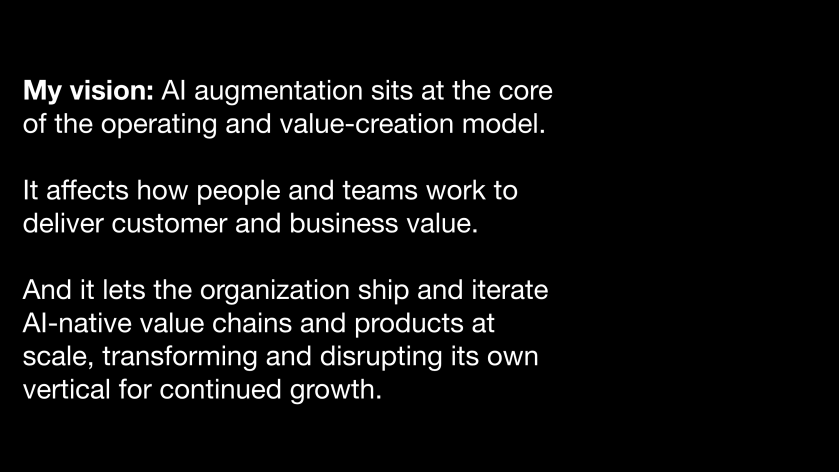
My role: as Zalando’s first-ever Head of AI Product Design, I set the AI customer experience and operational vision across the platform and teams, working with the CEO, SVPs and VPs across business units. Together with a core AI enablement and tooling team, I turned that vision into an actionable roadmap and transformed how product design and development work: internal agentic tools and AI platforms, new workflows and new job roles, scaled across disciplines.
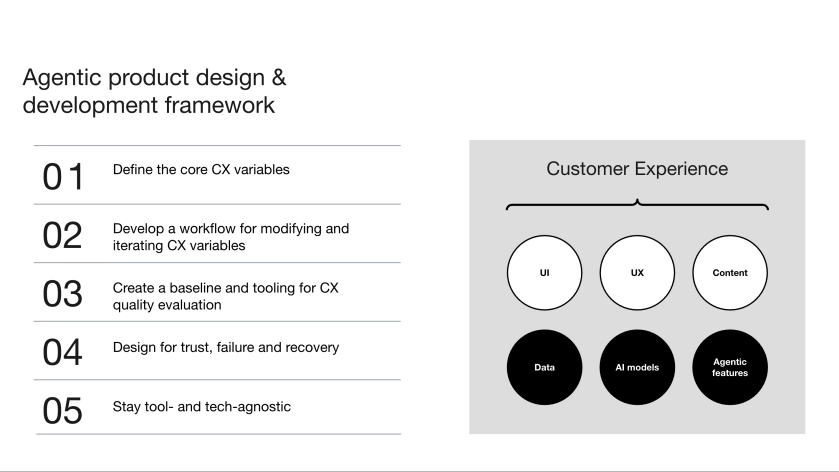
The approach: an agentic CX framework that 1) starts from the customer and business “why”, 2) treats the experience as a set of CX variables, from UI, UX and content to data, AI models and agentic features such as state, memory and tools, 3) gives every team a shared baseline for product design and development, evaluation and simulation, and 4) replaces sequential handoffs with parallel threads where design, engineering and data iterate together.
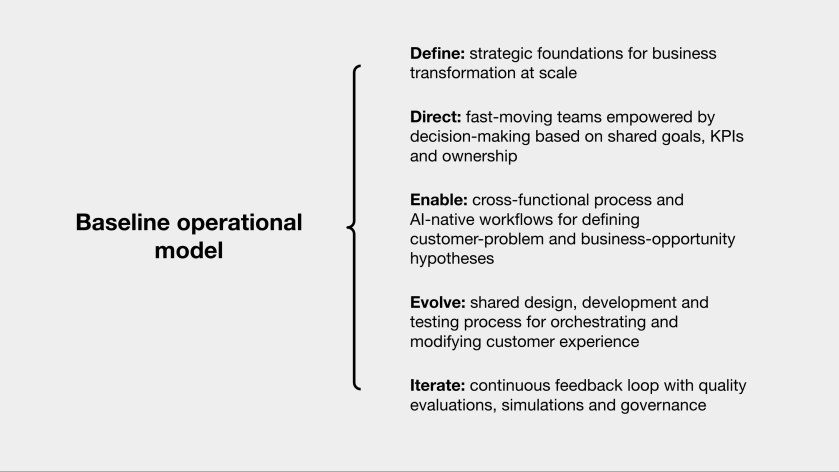
The operating model: define the strategic foundations for transformation at scale; direct fast-moving teams through shared goals, KPIs and ownership; enable cross-functional, AI-native workflows for customer-problem and business-opportunity hypotheses; evolve a shared design, development and testing process for orchestrating the customer experience; and iterate through continuous quality evaluation, simulation and governance.
Impact: within months, the team took Zalando’s product design foundations into the agentic era, including internal tooling to build rich interactive prototypes, and compare customer experiences across prompt versions, customer data, AI models and features such as memory, with observability and guardrails built in. The work also brought the design community together around hands-on AI practice, for example at Zalando’s AI Design Day.
Key learnings: 1) Don’t chase tools: start with your goals and use cases. 2) Behavior is the new interface: a change to memory logic or approval thresholds can shape the experience as much as a new screen. 3) Make quality visible: shared evaluation turns “does it feel right” into evidence the whole team can act on. 4) Transformation is built, not announced: new tools, roles and rituals have to be co-created with the people who use them.
Read more: How to build agentic CX frameworks (Zalando Design, 2026)
Trend Spotter and Dynamic Page System (2022-2025)
Data-driven trends and modular, personalized pages at scale
My role: led the customer experience design for Trend Spotter, which shows what is trending in Europe’s fashion capitals and explains why, and the CX vision for the module-powered Dynamic Page System, which lets Zalando build dynamic, personalized experiences at scale.
Impact: Trend Spotter gained significant organic traction and, after a successful run in six key markets, was rolled out to all Zalando markets, covering ten fashion capitals with weekly updates. The Dynamic Page System became a foundation for personalized experiences across the platform.
More: Zalando Trend Spotter
Yle: transforming a public service newsroom with AI (2016-2022)
First-ever Head of AI & Personalization at Yle News, Finland’s public service media company
Strategy and direction: set the AI and personalization strategy for Yle News, working closely with the CEO of News Operations and other executives, and with legal to drive compliant innovation in customer-facing and newsroom solutions.
From plan to execution: secured funding for key initiatives and built a multidisciplinary team from the ground up, creating new roles such as journalistic data producer and journalistic data scientist, together with the collaborative methods to make them work.
Operating model and impact: an AI-augmented operating model for a journalistic organization, and AI-powered news products for millions: Yle Uutisvahti became Yle’s fastest-growing digital service, Voitto was kept on by over 90% of its users, and Troll Factory won three international awards.
Yle News AI team (2018-2022)
A new journalistic AI/ML team, with methods and tools for AI-augmented news acquisition

My vision: journalists are augmented by machines in news acquisition, investigation and reporting.
Yle is the biggest news media company in Finland, and one of the leading public service media companies in Europe with the likes of BBC, NRK and ARD. Its headquarters is located in Helsinki.
Intrapreneurship in action: I led the development to bring design, AI and machine learning into the core of a big news media organization. I built a multidisciplinary team and collaborative methods from the ground up to develop machine learning powered tools for news acquisition and investigation. The method is based on continuous multidisciplinary collaboration between journalists and data scientists resulting in a combination of human knowledge/curation and machine learning. I was also responsible for organising and securing the internal funding for the strategic development project.
“This is the best concrete thing that has happened to our journalistic development.”
A seasoned journalistic producer at Yle News & Current Affairs
Impact: the multidisciplinary method and its machine learning powered tooling concretely showed how the combination of journalism, data science and machine learning creates value for the newsroom and its customers. Significantly, the developed method allowed the team to uncover several international level breaking news stories in a short period of time.
Key learnings: 1) Journalistic organizations need a multidisciplinary product and design talent/leadership in-house. The combination of journalism, AI and design is needed in the newsroom, and in the development teams and leadership teams alike. 2) In order to renew journalistic organization, new journalistic roles and processes have to be co-designed and co-created in the core of the newsroom (e.g. our team introduced completely new roles of journalistic data producer and journalistic data scientist). 3) Sustainable and future-proof development of the news media organization requires dedicated and systematic journalistic leadership with the up-to-date know-how on our developing media and information ecosystem. At the same time, the journalistic mission, values and goals should guide all prioritization, talent acquisition, team-building and development work.
More:
Yle News Lab builds a method that makes the power of social media visible
Machine learning courses for journalists (2020-2021)
With London School of Economics’ Polis (JournalismAI) and Google News Initiative

Helped to create practical machine learning courses for journalists (in 17 languages) as a part of an international multidisciplinary team consisting of journalists and data scientists.
Introduction to Machine Learning for journalists
“This Introduction to Machine Learning is built by journalists, for journalists, and it will help answer questions such as: What is machine learning? How do you train a machine learning model? What can journalists and news organisations do with it and why is it important to use it responsibly?”
Mattia Peretti, JournalismAI. London School of Economics and Political Science, Polis.
Impact: the basics of how machine learning can help journalists now available and easily accessible in 17 languages wherever you are.
Key learnings: 1) There’s a growing need in the field of journalism to understand how machine learning can concretely benefit journalism and its goals. 2) Ensure that the course is a journalism-first, not a tech-first experience.
Troll Factory (2019)
Award-winning educational game about information operations


Troll Factory edugame promotes media literacy by combining genuine social media examples with a gamified storytelling experience. The experience is personalized based on the player’s choices.
An intrapreneurial approach: built and led a multidisciplinary team from ideation of the initial concept to public launch for two localized versions of Troll Factory experience. Secured internal funding and executed all media reach-out.
Try it out: Troll Factory (English) and Trollitehdas (Finnish).
“‘Troll Factory’ puts you inside the seedy word of professional bull**** artists for a good reason: to help you spot misinformation when you see it.”
Mark Sullivan, Fast Company
“Troll Factory is sort of a choose-your-own adventure. You win by becoming the most malicious online troll. It’s a simulated smartphone screen…
I realized that the more I dial up the outrage, the more successful I become as a troll. The fake story really gets things going. My score surges. When I finish the game, I’ve hit 1,500 followers. They shared my post 14,000 times. I win the title director of disorder.”
Shannon Bond, NPR
Impact: Troll Factory has got significant international traction and it has already been played in over 100 countries across the globe. Among people using Troll Factory are professionals working with younger people (from public libraries to universities, schools and other educational institutions), students, media researchers and journalists as well as national security and cybersecurity professionals, who are interested in using Troll Factory as an educational material.
Key learnings: 1) The reporting on information warfare is comparable to war and catastrophe reporting. You need to show the raw reality to help people truly understand and comprehend the phenomenon. 2) In creating a personalized content experience, you need to test and iterate, and wash-rinse-and-repeat again in order to nail down the right rhythm and atmosphere. 3) This is a topic that can get under your skin. Focus on the communication and creating a psychologically safe environment inside the multidisciplinary team and magic can happen.
Selected coverage:
Awards:
World Digital Media Awards 2020, Best Project To Engage Younger Audiences
European Digital Media Awards 2020, Best Project To Engage Younger Audiences
Global Youth & News Media Prize 2019, News/Media Literacy category
Five million political ads (2019)
Targeted political advertising simulator


Five million political ads simulator shows concretely how your choices and actions in social media (likes/faves/shares/comments etc.) can affect the political advertising you see online. The experience is personalized based on the user’s choices.
Intrapreneurship in action: built and led the team from concept ideation to public launch for a unique simulation experience for targeted advertising.
“A great innovation by Yle.”
Olli-Pekka Heinonen, Director General of International Baccalaureate
Impact: simulation experience received an enthusiastic reception highlighting the need to make political advertising in social media more tangible and understandable. The experience was very frictionless as 92% of people starting the simulation completed it. Also, the user experience helped to concretely understand the dynamics of personalized content experience.
Key learnings: 1) Simplifying a very complex process of targeted political advertising was a great challenge for a newly formed multidisciplinary team. In this context, you need as a team to start by understanding the whole ecosystem, from political ideologies and their differentiating marketing messaging to the personalization methods used in social media, and then break it into comprehensible chunks for product design and development. 2) We wanted to create an experience that would let people without extensive background knowledge understand the basics of targeted advertising. To achieve that, all complexity was hidden under the hood to mimic the people’s actual experience in social media.
More:
Voitto news assistant (2018)
The first smart news assistant to learn directly on the lock screen


Voitto is the first smart news assistant in the world to appear and learn directly on your lock screen. The team set to create a human-centered and transparent personalization experience that would let people control how the news assistant works. The feedback loops for meaningful content recommendations had to be rethought so that the user could interact with Voitto assistant directly on their mobile lock screen. Voitto’s user experience and its tone of voice in these interactions was a crucial element: news content can contain information that can be very emotional and even upsetting. Thus Voitto’s interactions were designed to work for varying news content recommendations, from sports results to big unexpected news events.
An intrapreneurial approach: built and led the team from ideation of initial concept to public launch, also securing the internal funding for the product.
“The Finnish broadcaster YLE has spent a lot of time thinking about these issues as it develops its Voitto intelligent assistant… [It] collects feedback on AI-driven recommendations directly on the lockscreen – the first app to do so – and aims to build an on-going dialogue with users about the choices they make.”
Nic Newman, Oxford Reuters Institute
Impact: the users of Voitto have been extremely happy about its user experience and recommendations. Over 90% of Voitto’s users have kept Voitto on, its personalized recommendations surfacing on their lock screen making sure they don’t miss the news that matters to them. The development of Voitto gave completely new insights on the possibilities of machine learning for adaptive user experience, happening outside of any app.
Key learnings: 1) The tighter the concept, the more streamlined the execution: Voitto was taken from a concept to production in less than 6 months. 2) An early end-to-end pipeline for machine learning, including potential feedback loops, helped to understand and iterate fast both recommendation models, user experience and metrics. 3) You need to figure out the right metrics for an AI assistant to really understand its user experience and overall impact.
More:
Smart news assistant Voitto got quickly over 10k users (FI)
Coverage/mentions:
Oxford Reuters Institute’s Digital Trend Report 2019
London School of Economics, Polis
Läheltä / Near by (2017)
Localized news recommendations and news alerts


Läheltä / Near by recommendations and their lock screen notifications are based on the users current or selected location.
Led the team from concept ideation to public launch for a completely new personalization function in Yle News.
Impact: Läheltä / Near by recommendations and notifications quickly gathered a strong growing user base. Also, as the recommendations and notifications could be hyper-localized (for example for only one small town), the product helped Yle’s local newsrooms to create a new direct and real-time channel and relationship with their local users.
Key learnings: 1) Content-first approach needed from the very beginning. 2) Newsroom support crucial for success: there won’t be useful recommendations without diverse local journalistic content. 3) Leverage the existing tech for its full potential.
More:
Ainutlaatuinen palvelu kertoo nyt myös uutiset läheltä (FI)
Yle Uutisvahti / NewsWatch (2016-2018)
Productizing personalized news alerts and their adaptive content experience


The team redefined how personalization and news alerts could be useful for news consuming citizens. These data-driven insights were turned into actual mini-products and features, including content-focused interactive notification products containing images and videos (e.g. Herätys/Morning briefing, Pääuutiset/Main headlines, Viikon kiinnostavimmat/Weekend briefing, Sää/Weather), frictionless personalized onboarding (Sinulle/For You concept), real-time big news event reporting based on news alerts (Juuri nyt/Hetki hetkeltä/Developing story), a notification monitoring system for newsroom and the first concise news alerts strategy for the Yle’s newsroom.
I was also responsible for driving the development of a human-in-the-loop recommendation engine that used human input (for example in weighing news-worthiness as well as optimizing meta data) as a parameter in personalized news experience.
An intrapreneurial approach: built and led an agile multidisciplinary team to create an industry-defining news personalization experience by combining journalistic content, human curation, AI and adaptive user experience.
Impact: in 2017, Yle Uutisvahti app became Yle’s fastest growing digital service simultaneously getting international recognition for its trailblazing personalization features and creative design of its content-driven notification products. The users of the app are very committed, and the app received at the time high ratings both on iOS and Android platforms. Additionally, the team created concrete ways for the Yle newsroom to understand the effects and impact of well-thought news alerts. Significantly, after the implementation of new news alerts products and strategy, the users of Yle NewsWatch considered the app’s notifications to be as useful as personal text messages.
Key learnings: 1) Even the most foundational innovations don’t matter if there isn’t enough resources to scale them in their full potential. 2) Personalization is never solved, but it’s a continuously moving target. You need a multidisciplinary approach to truly focus on the right things and to understand their potential impact for the user and the product. 3) Personalization should serve the content creation, and content creation should serve the personalization.
Futureful: building a new product category from zero (2010-2015)
Co-founder, CCO of Futureful Inc. and CEO of Futureful Oy, Helsinki and San Francisco
Strategy and direction: translated an emerging technology, predictive personalization, into a real customer proposition without an existing playbook.
From plan to execution: built and led a multidisciplinary team across design, data science and engineering, took Random from concept to multiple public launches, and secured pre-seed and seed funding, including Tekes (now Business Finland) and a round led by Iconical, the VC fund of Skype co-founder Janus Friis.
Impact: a pioneering predictive discovery product covered by The New York Times, TechCrunch and MIT Technology Review, and a patent today cited by Google, Amazon, Microsoft, Adobe, Sony and IBM.
Random by Futureful (2010-2015)
Co-founded startup: predictive discovery app and recommendation engine


Co-founded an internationally renowned startup that developed a pioneering AI-powered predictive media discovery experience and recommendation engine from scratch.
I built and led the team, and as a co-founder secured our pre-seed and seed funding, including Tekes (now Business Finland) and a round led by Iconical, the VC fund of Skype co-founder Janus Friis. Additionally, I took care of the media relations, simultaneously leading the team from concept to multiple public launches.
“[Random] lets you browse the news in a different way to all the other news sites you’ve probably ever used.”
Kit Eaton, The New York Times
“Random never turns into a filter bubble, because it perpetually injects the irrational into my experience… in a cocktail of relevancy and serendipity.”
Claire Evans, Vice Motherboard
“Random… breaks you out by intentionally guiding you to new topics and interesting articles at sites you may not otherwise read.”
Alan Henry, Lifehacker
Impact: Random/Futureful pioneered human-centric, filter-bubble-breaking content discovery, and was praised both by its users and international media on its minimalistic design and depth of diverse content.
By combining relevance and serendipity, rich media content, a deep machine learning system and adaptive user experience, Random turned into a product that could truly help people discover new things they didn’t even know existed.
Random pioneered guided, serendipitous discovery patterns that later became mainstream in products such as Pinterest’s Guided Search and Snap’s Discover.
Key learnings: 1) In a startup you don’t need a map, you need a compass in keeping your endeavour on the right track. With the compass you’ll find the right metrics to measure your true progress. 2) Iterate in short enough cycles. Don’t make your progress and growth dependent on massive releases. Also, don’t try to solve too many problems at the same time or you lose the focus. 3) Product is important, but the story is crucial for a B2C startup. Make sure you have enough resources to make the story heard. Bonus: as an early stage startup, hire for hunger and learning speed; experience matters less than you think (obvious, yet not so obvious when you’re also doing deep engineering). Extra personal bonus: after doing field user research in the Valley in 2013 I was sure that the lock screen notifications, or news alerts, are the next important thing for personalization. Yet, I wasn’t effectively able to convince the team and push them to our product roadmap as the evidence of their coming significance was still too thin. A few years later, Voitto, the first smart news assistant on the lock screen, proved the point.
More:
Random app demo video · Random on YouTube
Selected coverage:
Patent
The core-technology patent on predictive data objects is today cited by Google, Amazon, Microsoft, Adobe, Sony and IBM (US 2011/0276632).
Let’s talk
Navigating a similar shift, from AI strategy to an AI-native operating model? I’m happy to compare notes. Connect · Read my writing · See my talks

